Publications
These are the publication that I have participated in. You can find the abstracts by pressing ABS, and I have provided the PDF file if available.
2024
- Sci. Rep.Development of EEG alpha and theta oscillations in the maintenance stage of working memoryShuting Huo, Jie Wang, Tak Kwan Lam, and 4 more authorsBiological Psychology, 2024
Several studies have shown developmental changes in EEG oscillations during working memory tasks. Although the load-modulated theta and alpha activities in adults are well-documented, the findings are inconsistent if children possess the adult-like brain oscillations that are similarly modulated by memory load. The present study compares children’s and adults’ true theta and alpha EEG oscillations, separated from aperiodic components, in the maintenance stage of working memory. The EEG was recorded in 25 Chinese-speaking children (14 male, Mage = 9.4 yrs) and 31 adults (19 male, Mage = 20.8 yrs) in Hong Kong while they performed an n-back task that included four conditions differing in load (1- vs. 2-back) and stimulus type (Chinese character vs. visual pattern). The results show that aperiodic activities (i.e., broadband power and slope) during the maintenance stage in the n-back task were significantly higher in children than adults. The periodic theta and alpha oscillations also changed with age. More importantly, adults showed significant periodic theta increase with memory load, whereas such an effect was absent in children. Regardless of age, there was a significant alpha power decrease with load increase, and a significant theta power enhancement when maintaining visual patterns than Chinese characters. In adults, load-modulated alpha peak shift (towards higher frequency) was linked to higher behavioral efficiency in the n-back task. In children, higher load-modulated theta enhancement was linked to better behavioral efficiency. The findings suggest that the load-modulated theta power during working memory maintenance matures from childhood to adulthood.
@article{Huo_2024,
  title = {Development of EEG alpha and theta oscillations in the maintenance stage of working memory},
  journal = {Biological Psychology},
  volume = {191},
  pages = {108824},
  year = {2024},
  issn = {0301-0511},
  doi = {https://doi.org/10.1016/j.biopsycho.2024.108824},
  url = {https://www.sciencedirect.com/science/article/pii/S0301051124000838},
  author = {Huo, Shuting and Wang, Jie and Lam, Tak Kwan and Wong, Brian W.L. and Wu, Ka Chun and Mo, Jianhong and Maurer, Urs},
  keywords = {EEG oscillations, Periodic components, Aperiodic components, Working memory, Development},
}
2022
- Sci. Rep.Behavioral and neurophysiological aspects of working memory impairment in children with dyslexiaJie Wang, Shuting Huo, Ka Chun Wu, and 3 more authorsScientific Reports, 2022
The present study aimed to identify behavioral and neurophysiological correlates of dyslexia which could potentially predict reading difficulty. One hundred and three Chinese children with and without dyslexia (Grade 2 or 3, 7- to 11-year-old) completed both verbal and visual working memory (n-back) tasks with concurrent EEG recording. Data of 74 children with sufficient usable EEG data are reported here. Overall, the typically developing control group (N = 28) responded significantly faster and more accurately than the group with dyslexia (N = 46), in both types of tasks. Group differences were also found in EEG band power in the retention phase of the tasks. Moreover, forward stepwise logistic regression demonstrated that both behavioral and neurophysiological measures predicted reading difficulty uniquely. Dyslexia was associated with higher frontal midline theta activity and reduced upper-alpha power in the posterior region. This finding is discussed in relation to the neural efficiency hypothesis. Whether these behavioral and neurophysiological patterns can longitudinally predict later reading development among preliterate children requires further investigation.
@article{Wang_2022,
  doi = {https://doi.org/10.1038/s41598-022-16729-8},
  url = {https://doi.org/10.1038/s41598-022-16729-8},
  title = {Behavioral and neurophysiological aspects of working memory impairment in children with dyslexia},
  author = {Wang, Jie and Huo, Shuting and Wu, Ka Chun and Mo, Jianhong and Wong, Wai Leung and Maurer, Urs},
  journal = {Scientific Reports},
  volume = {12},
  number = {1},
  pages = {12571},
  year = {2022},
  publisher = {Nature Publishing Group UK London},
}
2021
- J. Learn. Disabil.Children With Chinese Dyslexia Acquiring English Literacy: Interaction Between Cognitive Subtypes of Dyslexia and OrthographiesShuting Huo, Ka Chun Wu, Jianhong Mo, and 2 more authorsJournal of Learning Disabilities, Jun 2021
This study investigated the impact of Chinese dyslexia subtypes on English literacy skills (i.e., reading fluency and dictation) in Hong Kong children. Eighty-four Cantonese-speaking children officially diagnosed with dyslexia (Mage = 103 months) and 48 age-matched typically developing (TD) children were tested. Cluster analysis with performances on Chinese syllable awareness (CSA), Chinese phonemic awareness (CPA), Chinese phonological memory (CPM), Chinese orthographic awareness (COA), and matrix reasoning (MR) yielded three cognitive subtypes: the phonological deficit (PD) subtype, the orthographic deficit (OD) subtype, and the global deficit (GD) subtype. After controlling for English language experience, age, and gender, all three dyslexia subtype groups performed significantly worse in English word reading fluency and dictation than the TD children. In addition, the PD group performed worse in English PA; the OD group performed worse in English OA; and the GD group performed worse in all English skills except English PM. We compared the level of impairment in literacy between languages and dyslexia subtypes. In word reading fluency, all subtype groups experienced less impairment in English than Chinese, while the OD group showed the largest English advantage. In dictation, only the OD group showed a significant language effect favoring English. The findings suggest that different subtypes of Chinese dyslexia bear different risks for difficulties in English literacy.
@article{Huo_2021, doi = {10.1177/00222194211017819}, url = {https://doi.org/10.1177/00222194211017819}, year = {2021}, month = jun, publisher = {{SAGE} Publications}, volume = {55}, number = {3}, pages = {229-241}, author = {Huo, Shuting and Wu, Ka Chun and Mo, Jianhong and Wang, Jie and Maurer, Urs}, title = {Children With Chinese Dyslexia Acquiring English Literacy: Interaction Between Cognitive Subtypes of Dyslexia and Orthographies}, journal = {Journal of Learning Disabilities}, } - CNS*2021
 Does reward positivity encode trial-by-trial reward prediction error? A model-based EEG analysisKa Chun Wu, Isaac Ip, Fiona Ching, and 5 more authorsIn 30th Annual Computational Neuroscience Meeting: CNS*2021, Jul 2021
Reward positivity (RewP), an event-related potential observed 250–300 ms after feedback, is hypothesized to reflect the dopaminergic response to the reward prediction error (RPE) during the reward processing. However, the traditional grand averaging approach of ERP analyses cannot answer whether RewP is merely a response to RPE valence in a categorical way (i.e., better-than-expected or worse-than-expected) or reflects the computation of RPE in a parametric way. In this study, we take a model-based approach to explore the effect of RPE on RewP. Specifically, we use the hierarchical Bayesian modelling to estimate individual parameter under the reinforcement learning model and extract the trial-by-trial RPE as the regressor for model-based EEG analysis.
Thirty-seven healthy adults (19 male, 18 female, Mean age = 26.97) performed four blocks of probabilistic reversal learning task while we acquire their EEG response using a 128-channel system. The preprocessed data were segmented into 1000 ms epoch from -200 ms before to 800 ms after the feedback slides. The reinforcement learning model based on Rescorla Wagner model with separate learning rates for positive and negative feedbacks was fitted with the choice data of the subjects to estimate the hyper-parameter and individual parameters using the hBayesDM package. Using the fitted parameters, the trial-by-trial RPE is generated and input as the trial-by-trial regressors for the model-based EEG analysis using the LIMO-EEG plugin of EEGLAB.
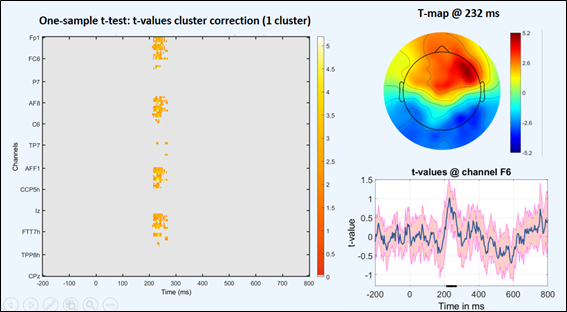
Traditional ERP analysis found a P200, FRN, and P300 effect of feedback valence at FCz (Fig. 1A). For the model-based analysis, one-sample t-test is applied to condition contrast (reward vs. non-reward) and RPE contrast (positive RPE vs. negative RPE). While no significant cluster is found for condition effect after correction for multiple comparisons using spatiotemporal clustering, the results reveal a significant modulation of ERP for positive RPE than for negative RPE (Fig. 1B – cluster started at 212 ms and ends at 268 ms encompassing frontocentral electrodes, mean beta value = 0.68, 95% CI [-0.07 1.42], maximum t-value = 5.20 at 232 ms channel F6, corrected p-value = 0.003). The results support that a more positive RPE predicts a more positive EEG response at frontocentral region, though the corresponding time is earlier than the typical RewP time window. Model-based analysis provides an alternative angle to the average-based RewP and shed a new light on the temporal dynamic of reward computation. It provides direct evidence that the “early” RewP encode positive RPE in a parametric way.@inproceedings{conference_2021, doi = {10.1007/s10827-021-00801-9}, title = {Does reward positivity encode trial-by-trial reward prediction error? A model-based EEG analysis}, author = {Wu, Ka Chun and Ip, Isaac and Ching, Fiona and Chiu, Heytou and Chan, Rosa and Chau, Bolton K. H. and Wong, Savio W. H. and Wong, Yetta Kwailing}, year = {2021}, month = jul, booktitle = {30th Annual Computational Neuroscience Meeting: CNS*2021}, publisher = {Springer Science and Business Media LLC}, address = {Online}, series = {Journal of Computational Neuroscience}, volume = {49}, number = {Suppl 1}, pages = {S193-S194}, organization = {Organization For Computational Neurosciences}, }

2020
- Dev. Sci.Remediation of a phonological representation deficit in Chinese children with dyslexia: A comparison between metalinguistic training and working memory trainingJie Wang, Ka Chun Wu, Jianhong Mo, and 6 more authorsDevelopmental Science, Nov 2020
A form-preparation task in the language production field was adopted to examine output phonological representations in Chinese dyslexia and their susceptibility to training. Forty-one Chinese children with dyslexia (7–11 years old) and 36 chronological age controls completed this task. The controls demonstrated a marginally significant syllable facilitation effect (d = −0.13), indicating their use of syllable-sized phonological representations during speech production, while the group with dyslexia showed a significantly different pattern (d = 0.04), opposite to the direction of a facilitation effect. The children with dyslexia were then randomly assigned to either metalinguistic training (N = 22) or working memory training (N = 19). Only the metalinguistic training subgroup demonstrated a significant syllable facilitation effect afterward (metalinguistic: d = −0.13; working memory: d = −0.01). The results suggest the presence of a phonological representation deficit at the syllable level in Chinese dyslexia and its possible remediation by metalinguistic training. Such a phonological deficit in readers of a logographic script strongly supports the impaired phonological representation view of developmental dyslexia. A video abstract of this article can be viewed at https://youtu.be/zT2Be0xMkh0.
@article{Wang_2020, title = {Remediation of a phonological representation deficit in Chinese children with dyslexia: A comparison between metalinguistic training and working memory training}, volume = {24}, issn = {1467-7687}, url = {http://dx.doi.org/10.1111/desc.13065}, doi = {10.1111/desc.13065}, number = {3}, journal = {Developmental Science}, publisher = {Wiley}, author = {Wang, Jie and Wu, Ka Chun and Mo, Jianhong and Wong, Wai Leung and Siu, Tik Sze Carrey and McBride, Catherine and Chung, Kevin Kien Hoa and Wong, Patrick C. M. and Maurer, Urs}, year = {2020}, month = nov, } - CNS*2020
 Loss aversion and outcome-value encoding: a negative association between posterior insula activity and loss aversion coefficientKa Chun Wu, Isaac Ip, Fiona Ching, and 3 more authorsIn 29th Annual Computational Neuroscience Meeting: CNS*2021, Jul 2020
In prospect theory, loss aversion is one important parameter that modulates one’s decision in involving risk. Previous studies find that amygdala activity is related to the degree of loss aversion during the action-selection processes. In this study, we examine the brain response associated with decision outcome and how that varies across subjects with different degrees of loss aversion. We expect that people with high loss aversion experience stronger emotional impact when receiving a negative outcome after taking risk. We hypothesize a person’s degree of loss aversion could be reflected by the BOLD contrast across decision outcomes.
To test this hypothesis, we recorded and analysed the fMRI data of twenty-one participants (10 males and 11 females; M age = 17.9 ± 0.75) during the Loss Aversion Task (LAT). The LAT was implemented with a rapid event-related design in which participants were given two options: NoGamble option with a guaranteed outcome and Gamble with 50% chance of getting a better-than-NoGamble outcome and 50% chance of getting a worse-than-NoGamble outcome. The utility of the two options varied so that one option has higher or equal utility respect to another. Participants were presented with a feedback indicating the outcome. Loss aversion coefficient (lambda; ƛ= −beta loss / beta gain) is estimated by fitting the behavioural responses to the logistic function. A higher lambda value indicates stronger loss aversion, with ƛ = 1 meaning equal weight for gain and loss.
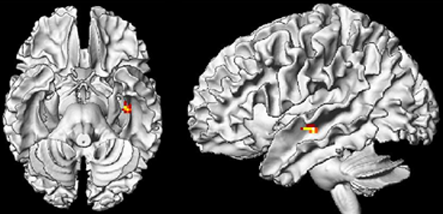
We find feedback-related activities at medial prefrontal cortex (mPFC) but find no significant difference among the valence of feedback (gain, loss, no-gain/loss). Condition contrasts reveal that the activity of the left posterior insular cortex during gambling loss relative to guaranteed loss is negatively correlated with participants’ lambda. In the other words, gambling loss elicit stronger insula response relative to guaranteed loss in participants with lower lambda, while those with higher lambda do not differentiate between gambling and guaranteed loss. The insular cortex potentially increases the sensitivity of the anticipated loss, or alternatively, reduces the sensitivity to the gamble loss. Both interpretations lead to the likelihood a person choose to take risk in a long run given both gambling loss and guaranteed loss had similar subjective value in the past. In conclusion, the individual difference in loss aversion could be capture by condition contrasts in a LAT and gives insight to the model of outcome-value encoding.@inproceedings{conference_2020, doi = {10.1186/s12868-020-00593-1}, title = {Loss aversion and outcome-value encoding: a negative association between posterior insula activity and loss aversion coefficient}, author = {Wu, Ka Chun and Ip, Isaac and Ching, Fiona and Chiu, Heytou and Chan, Rosa and Wong, Savio W. H.}, year = {2020}, month = jul, booktitle = {29th Annual Computational Neuroscience Meeting: CNS*2021}, publisher = {Springer Science and Business Media LLC}, address = {Online}, series = {BMC Neuroscience}, volume = {21}, number = {Suppl 1}, pages = {117}, organization = {Organization For Computational Neurosciences}, }
